Patricia Highsmith, Author of Strangers on a Train & the Ripley Series
By Nava Atlas | On July 15, 2018 | Updated September 27, 2025 | Comments (0)
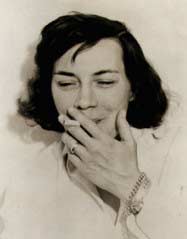
Patricia Highsmith (January 19, 1921 – February 4, 1995) was an American writer known for novels and short stories best described as psychological thrillers. She wove murder, crime, and intrigue through her plots, which were often driven by sociopathic antiheroes.
Born Mary Patricia Plangman in Fort Worth Texas, her parents divorced just days before her birth. She acquired the name Highsmith when her mother remarried a few years later.
Recalling her unhappy childhood as “a little hell,” she disliked her mother and stepfather, who argued constantly. Perhaps that figured into her dim view of human nature, as by age eight she was reading studies of mental illness. Finding them fascinating, some of what she learned may have been tucked away for use in her writing.
Highsmith attended Barnard College in New York City, where she majored in English, focusing on playwriting and composition. For some years after graduating, she worked as a scriptwriter for comic books.
Strangers on a Train
She burst onto the literary scene when her first novel, Strangers on a Train, was published in 1950. It was followed just a year later by the 1951 film adaptation directed by Alfred Hitchcock. With that, her reputation was secured.
Her prolific output was dominated by thrillers that didn’t shy away from the dark places of the human psyche. She seemed to especially like creating plot lines that exposed torturous relationships between men (not in the romantic sense). She wasn’t influenced by other crime and mystery authors, preferring to get her inspiration from reading about crimes in the press.
. . . . . . . . . .

Strangers on a Train put Patricia Highsmith on the literary map
. . . . . . . . . .
Sociopaths, murderers, and Ripley
Sociopaths and murderers populate Highsmith’s most enduring works, which, in addition to the aforementioned Strangers on a Train. Highsmith once said, “I rather like criminals and find them extremely interesting, unless they are monotonously and stupidly brutal.”
The Talented Mr. Ripley came along in 1956 and Thomas Ripley, the sociopathic anti-hero who went on be the central character of four subsequent novels that came to be known as “the Ripliad.” The first installment was followed by Ripley Under Ground, Ripley’s Game, The Boy Who Followed Ripley, and Ripley Under Water.
Tom Ripley is a likable sort of fellow, setting aside the fact that he murders his best friend and then goes about Europe impersonating him. Like many of Highsmith’s characters, Tom Ripley is a con artist and murderer. Highsmith described him as “suave, agreeable, and utterly amoral.” He’s cultured, charming, and often portrayed as likable, which puts the reader in a moral bind — just as the author intended.
Several film adaptations emerged from that series. The first was The American Friend (1977) starring Dennis Hopper and based on Ripley’s Game. The most successful was the 1999 film, The Talented Mr. Ripley, starring Matt Damon and Jude Law.
Fascinated by the criminal mind, she specialized in creating morally corrupt characters who often managed to escape punishment. “Is there anything more artificial and boring than justice?” she pondered. “I invent stories, it is not my aim to morally re-arm the reader — I want to entertain.”
. . . . . . . . . .
Romantic Quotes from The Price of Salt
. . . . . . . . . .
The Price of Salt
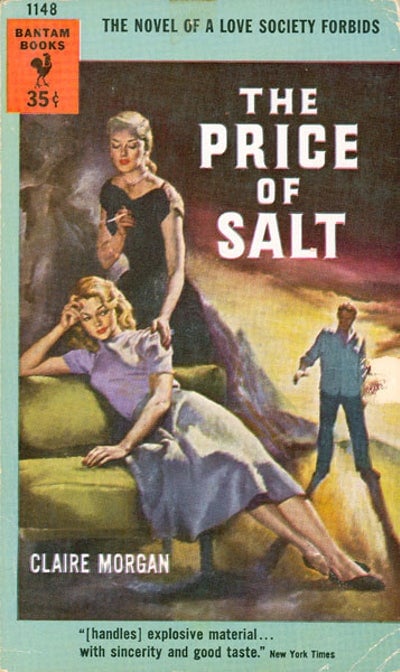
Early in her career, Highsmith took a hiatus from criminals and murderers to write The Price of Salt (1952) under the pseudonym Claire Morgan. It was the first time a published book about a lesbian love affair didn’t end in tragedy — quite a breakthrough for its time.
In the 1950s, the lesbian pulp genre blossomed, but in order to get past the censors, at least one of the women in the relationship had to go mad, kill herself, or realize that she was straight, after all. In The Price of Salt, the women end up together. It’s not clear why this novel was able to get past the censors with an actual happy ending.
The book sold nearly a million copies. Many decades after its publication, the novel has been adapted for the screen (the 2015 film adaptation is titled Carol) and stars Rooney Mara and Cate Blanchett.
. . . . . . . . . .

. . . . . . . . . .
A misanthrope
Highsmith was bisexual; her relationships with men and women never lasted more than a few years. She never married or had children. She was an alcoholic, and was sometimes cruel to her intimates, though plenty of people found her engaging and fascinating. She was known to say, “My imagination functions much better when I don’t have to speak to people.”
She was often described as a misanthrope who preferred animals (especially cats) to people. However, she was no cozy cat mom. Though she grieved her cats bitterly when their time came, a former lover of hers noted that she wouldn’t have wanted to be one of Highsmith’s cats.
In her 1975 collection of short stories, The Animal Lovers Book of Beastly Murders, animals take violent revenge on humans.
Patricia Highsmith’s Legacy
Patricia Highsmith won numerous accolades for her work. She received awards from organizations like the Mystery Writers of America and won the praise of fellow authors.
Graham Greene described her as a “writer who has created a world of her own — a world claustrophobic and irrational which we enter each time with a sense of personal danger.” About Greene, she said: “I have Graham Greene’s telephone number, but I wouldn’t dream of using it. I don’t seek out writers because we all want to be alone.”
“I cannot think of anything worse or more dangerous than to discuss my work with another writer. It would give me an uncomfortably naked feeling,” is an apt quote about her desire to be left to her own devices, from her slim guide Plotting and Writing Suspense Fiction (1966).
The London Times Literary Supplement described her in 1975 as “the crime writer who comes closest to giving crime a good name.”
Highsmith moved to Europe in 1963. She lived her later years in Italy, France, and Switzerland, and criticized Americans of being too provincial and not understanding the rest of the world. She died at age 74 in Switzerland of unknown cause.
More about Patricia Highsmith
On this site
Major Works (fiction)
- Strangers on a Train (1950)
- The Price of Salt (Claire Morgan, pseudonym, 1952)
- The Blunderer (1954)
- Deep Water (1957)
- A Game for the Living (1958)
- This Sweet Sickness (1960)
- The Cry of the Owl (1962)
- The Two Faces of January (1964)
- The Glass Cell (1964)
- A Suspension of Mercy (1965)
- Those Who Walk Away (1967)
- The Tremor of Forgery (1969)
- A Dog’s Ransom (1972)
- Little Tales of Misogyny (1974)
- Edith’s Diary (1977)
- The Black House (1981)
- Mermaids on the Golf Course (1985)
- Small g: a Summer Idyll (1995)
The Ripley Novels (known as “The Ripliad”)
- The Talented Mr. Ripley (1955)
- Ripley Under Ground (1970)
- Ripley’s Game (1974)
- The Boy Who Followed Ripley (1980)
- Ripley Under Water (1991)
More about Patricia Highsmith
- The Haunts of Miss Highsmith
- My Hero: Patricia Highsmith
- Joan Schenkar on Patricia Highsmith (The New Yorker)
- NYFF Review: Carol
Biographies
- Beautiful Shadow: A Life of Patricia Highsmith by Andrew Wilson
- The Talented Miss Highsmith by Joan Schenkar
- Highsmith: A Romance of the 1950s by Marijane Meaker
Archive
Selected Film and Television adaptations
More than two dozen film adaptations have been made of Highsmith’s works. Here are a few of the best known:
- Strangers on a Train (1951)
- The American Friend (1977)
- The Talented Mr. Ripley (1999)
- Ripley’s Game (2003)
- Carol (adaptation of The Price of Salt, 2015)
Leave a Reply