10 Fascinating Facts About Louise-Élisabeth Vigée Le Brun
By Judith Lissauer Cromwell | On July 10, 2025 | Comments (0)
The latest biography from historian Judith Lissauer Cromwell, Louise-Élisabeth Vigée Le Brun: Portrait of an Artist, 1755–1842 (McFarland, 2025), follows the remarkable life of this painter whose portraits of European royalty and nobility hang in many of the world’s most important museums.
As a young woman in the male-dominated society of 18th-century France, Louise-Élisabeth Vigée Le Brun was denied an artistic education and forced to nurture her passion outside of conventional schooling. Vigée Le Brun’s vibrant art, in addition to her charm and beauty, caught the attention of Queen Marie-Antoinette, who honored her as her chosen painter.
At the pinnacle of her fame and fortune, however, the Revolution forced Vigée Le Brun to flee, leaving everything behind except her only child, a daughter.
Drawn from Vigée Le Brun’s memoirs, archival research, and reexamination of the judgment of her contemporaries, this biography paints a fascinating picture of a single working mother who survived because of her cachet, charisma, and artistic talent.
Cast on a storm-tossed continent, solely reliant on her palette, she produced some of her major works during her twelve-year exile, returning to France to continue her work after Napoleon had restored stability. Vigée Le Brun’s story is one of triumph, adversity, perseverance and ultimately, peace.
Judith Lissauer Cromwell has contributed 10 fascinating facts about Louise-Élisabeth Vigée Le Brun, a painter whose life and work merits wider recognition.
Vigée Le Brun was a feminine icon in her day
Famed throughout Europe and North America for her portraits, Vigée Le Brun, a lover of art, music, letters, and nature, had traveled widely. She knew everybody who mattered in the European world of culture and politics and had painted many of them.
. . . . . . . . . .
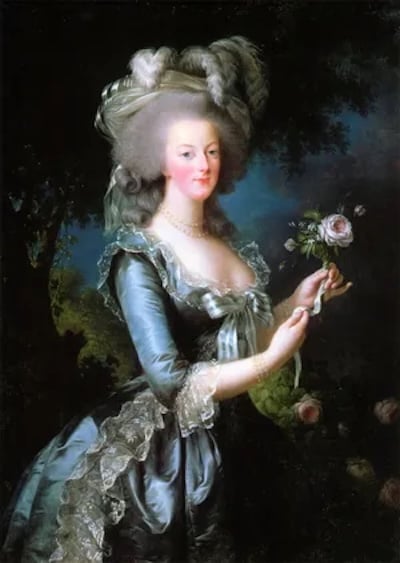
Portrait of Quieen Marie Antoinette
by Louise-Elisabeth Vigee-Lebrun, Versailles Museum
. . . . . . . . . .
She was Queen Marie-Antoinette’s favorite artist
Marie-Antoinette’s exacting mother, the Empress of Austria, wanted a formal portrait of her daughter as Queen of France. Several prominent male artists had, over a ten-year period, failed to please. Desperate, Marie-Antoinette decided to try a young female artist who had become the fashion in Paris. Vigée Le Brun’s Marie-Antoinette in Full Court Dress succeeded. This joint triumph created a bond between queen and artist.
Vigée Le Brun painted many portraits of Marie-Antoinette. Some went to the queen’s friends in foreign countries, others to French embassies in foreign capitals. King Louis XVI presented a formal portrait of himself and of Marie-Antoinette (by Vigée Le Brun) to the US Congress to mark the birth of the new nation. Exposure as the French queen’s painter brought her universal fame.
Vigée Le Brun was basically self-taught
Barred from a traditional art education because of her gender, Vigeé Le Brun relied on herself to nurture her passion for painting and her ambition to be a great artist. She developed her unique style by studying master painters.
. . . . . . . . . .
She had an unsatisfactory marriage
At age twenty, the painter made a marriage of convenience to a prominent Parisian art dealer, mainly to escape an unhappy home life. He was not “a bad man,” Vigée Le Brun tells us, “his nature showed a great mixture of sweetness and vivacity; he treated everyone very kindly…a likeable person. But his reckless passion for women of ill repute, combined with his lust for gambling, resulted in the loss of his fortune and mine, which he fully controlled.”
Jean-Baptiste Pierre Le Brun divorced his wife during her exile, which allowed the painter full control of her earnings so that when she returned to France, Vigée Le Brun had enough to live on comfortably.
. . . . . . . . . .
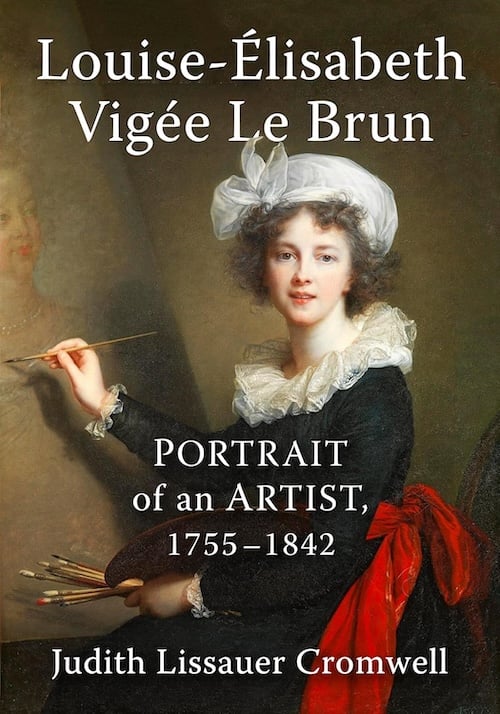
Louise-Élisabeth Vigée Le Brun: Portrait of an Artist, 1755–1842
is available wherever books are sold
. . . . . . . . . .
Vigée Le Brun was socially prominent
Her pretty face, attractive figure and sense of fashion, her charm and gift for making friends, but above all her talent and determination to succeed, propelled the young painter into the top echelons of scintillating Old Régime society.
The only artist with a salon in the heyday of Paris salons, Vigée Le Brun’s salon attracted prominent members of the bohemian world of arts and letters and aristocrats bored by the stiff formality of Versailles. It did not matter if the simple food ran out, or a prince of the blood had to sit on the floor because there were not enough chairs; music, laughter, and good conversation satisfied everyone.
She was fashion-forward
Frustrated by the Versailles court’s formal, ornate, and uniform dress with its stiff corsetry, its blank rouged faces under elaborately coiffed hair, Vigée Le Brun persuaded her sitters to wear simple, pliant, muslin dresses and shawls, unpowdered, naturally arranged hair, and minimal makeup. Vigée Le Brun made an effort to get to know her subjects so that she could portray them as vital human beings.
Having helped to promote a simpler way of dressing in Paris, Europe’s fashion capital, Vigée Le Brun introduced her style to St. Petersburg, where she spent half of her twelve-year exile. The new fashion became so popular that aristocratic ladies were able to convince an extremely reluctant Catherine the Great to allow it at official court functions.
Vigée Le Brun suffered vicious calumny
The public’s love of reading salacious gossip about the rich and famous stimulated the fertile imagination of pamphleteers. Pre-revolutionary Paris buzzed with made-up tales, especially about Marie-Antoinette and, since she and Vigée Le Brun were as much friends as two women of such disparate social levels could be, some of the fabricated mud flung at the queen spattered onto her favorite painter.
Vigée Le Brun could ill afford to ignore the slander because, as a female artist, her credibility depended on keeping her spotless reputation. The lies Parisian pamphleteers spread about Vigée Le Brun were a major reason for her flight from Paris as the Revolution ramped up.
. . . . . . . . . .
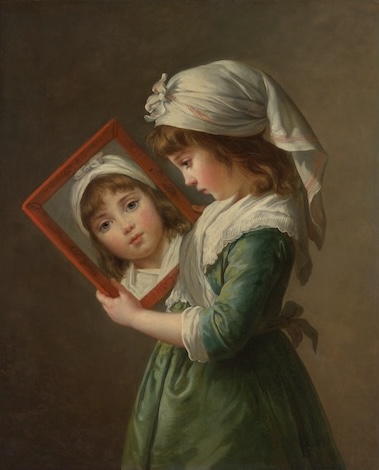
Julie Le Brun by Louise Elisabeth Vigee Le Brun
(image courtesy of the Metropolitan Museum of Art’s Open Access)
. . . . . . . . . .
She suffered great tragedy in losing her daughter
Vigée Le Brun adored her only child. She took pretty little Julie with her into exile, lavished love and attention on her, and made sure she had an excellent education. At age nineteen Julie fell in love with a handsome nonentity. Vigée Le Brun opposed their marriage; the ensuing fracas revealed Julie’s less attractive qualities and caused an irreparable rift with her mother. The marriage ended badly; and syphilis led to Julie’s early death.
Vigée Le Brun wrote her memoirs
Reflecting on her legacy towards the end of her life, on the cruel and unmerited slander she, as a successful woman in a man’s world, had suffered, Vigée le Brun decided to seize control of her life story by creating her last self-portrait. Souvenirs recounts Vigée Le Brun’s life as she wanted posterity to know it; Souvenirs also presents posterity with Vigée Le Brun’s last, vivid, and richly colored depiction of the Old Régime.
Her paintings have two-fold importance
Today, Vigée Le Brun’s paintings hang in some of the world’s most important galleries, not only for their artistic value but also because she immortalized many of Europe’s movers and shakers at a time when the West stood at the cusp of the modern age.
. . . . . . . . . . .
About the author, Judith Lissauer Cromwell: After a successful corporate career, Judith returned to academia as an independent historian and biographer of powerful women. Her experience as a magna cum laude graduate of Smith College, holder of a doctorate in modern European history with academic distinction from New York University, veteran of corporate America, mother, and grandmother, enrich Cromwell’s perspective on strong women in history.
She is the author of the biographies Dorothea Lieven: A Russian Princess in London and Paris, 1785-1857; Florence Nightingale, Feminist; and Good Queen Anne: Appraising the Life and Reign of the Last Stuart Monarch. Her latest biography, Louise-Élisabeth Vigée Le Brun: Portrait of an Artist, 1755-1842 provides a fresh and balanced perspective on the life of a renowned, yet often overlooked, painter. Learn more about Judith’s work at JudithCromwell.com.
. . . . . . . . . .
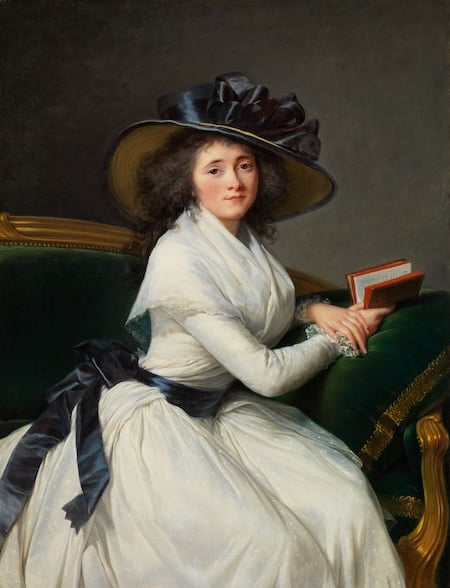
Comtesse de la Châtre (Marie Charlotte Louise Perrette Aglaé Bontemps, 1762–1848)
by Louise-Elisabeth Vigee Le Brun
(image courtesy of the Metropolitan Museum of Art’s Open Access)
An Interview with Judith Lissauer Cromwell
What inspired you to write about Vigée Le Brun?
I had never heard of Vigée Le Brun until New York’s Metropolitan Museum of Art held a retrospective of her work. Reviewers praised the exhibit, so I went to see it. Vigée Le Brun’s
paintings were riveting, her brief introductory biography intriguing. This remarkable woman, I vowed to myself, would be the subject of my next book.
Why is Vigée Le Brun, the most sought after portraitist in late 18th and early 19th century Europe, not well-known today?
Until the present day, art historians (mostly male) have generally tended to ignore female artists. Because of her association with Marie Antoinette and the court at Versailles, Vigée Le Brun became famous as a court painter. Certainly, she focused on the aristocracy and the French
court before the Revolution, but both before and after the Revolution, her work, indeed, some of her most celebrated paintings, are not of aristocrats.
What is the most surprising thing you discovered about Vigée Le Brun?
The tremendous hurdles she faced in achieving her goal to become a great artist. What a multi-faceted woman she was. How the political events she lived through affected her even though she had little to no interest in politics. Her resilience; how she managed to continue her brilliant career during twelve years of exile far from her beloved family and homeland.
Why have you focused on only fifty of Vigée Le Brun’s paintings when her complete oeuvre includes around eight hundred? How did you decide which paintings to include in your biography?
Rather than cramming into the book as many illustrations as possible from Vigée Le Brun’s copious work, I decided to highlight paintings that are either especially important in her life or exemplify her most illustrious efforts.
Why does Vigée Le Brun’s art, life, and legacy matter to readers today?
Despite incredible odds, she achieved her childhood goal of becoming a great artist early in life. Aside from her art and the fame it brought her, Vigée Le Brun’s diverse interests, not to mention her looks, charm, and social position (everyone who mattered in the world of culture, society, and politics knew her) made Vigée Le Brun a feminine icon. Dedication to her art brought Vigée Le Brun solace in times of stress and happiness regardless of life’s knocks.
Which museums hold a selection of Vigée Le Brun’s paintings? Where should readers go to see her art in person?
New York’s Metropolitan Museum of Art and the Louvre (Paris) currently have some of Vigée Le Brun’s paintings on view; The Hermitage, (St.Petersburg, Russia); the National Gallery, (London); and the Versailles et Trianon museums (Versailles, outside Paris) all own several of Vigée Le Brun’s paintings.
Leave a Reply